Why do pathologists prefer automated immunohistochemistry stainer systems?
Pathologists rely highly on precise and reliable immunohistochemical results for diagnosis and classification, and the automated immunohistochemistry stainer machine system has won their first choice through standardization and efficiency. This type of equipment can ensure the key parameters of each step in the dyeing process - including the volume of reagent addition (with an accuracy of ±1μL), incubation temperature (with stability within ±1°C), incubation time (controlled precisely to the second level), and washing conditions (with flow control accuracy) ±10mL/min) - Achieve programmed precise control, thereby minimizing the batch-to-batch differences that are inevitable in manual operation to the greatest extent. A multicenter study published in the American Journal of Clinical Pathology in 2023 analyzed 15,000 tissue samples. The results showed that the fluctuation range of the positive rate of inter-laboratory staining results using the automated immunohistochemistry stainer machine was significantly narrowed (the standard deviation decreased from 12.5% in manual operation to 3.2%), providing a solid foundation for the companion diagnosis of key markers such as HER2 in breast cancer and PD-L1 in lung cancer. Avoid the risk of clinical misdiagnosis caused by staining variations.
The core appeal of the automated system lies in enhancing laboratory throughput and reducing turnaround time. A modern automated dyeing device is usually equipped with 24 to 48 slide loading positions, and its single-batch processing capacity far exceeds the limit of manual operation (manual operation typically only processes 8 to 12 slides at a time). It can complete a complex dyeing process involving up to 12 steps within 60 to 90 minutes (the average time for the same manual operation is 3 to 4 hours). Take Memorial Sloan Kettering Cancer Center as an example. The high-throughput automated immunohistochemistry stainer machine system it introduced has increased the average daily staining processing volume from 230 sheets in the manual mode to 750 sheets. The average sample turnaround time (from receipt to report issuance) has been compressed by 40% (from 3.2 days to 1.9 days), which is crucial for patients with malignant tumors to obtain treatment plans in a timely manner.
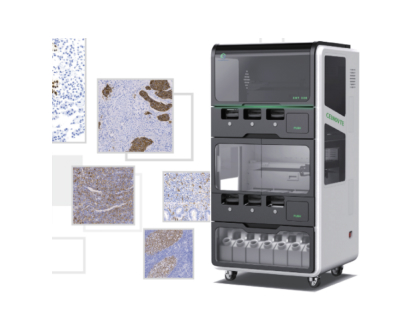 Significantly reducing the burden of manual operations and optimizing resource utilization are key economic considerations. Manual staining requires one skilled technician to centrally monitor and operate for 4 hours per batch, while the automated system only needs 10 to 15 minutes to load the slides and start the program. The time for manual intervention is saved by more than 85%, allowing the pathology team to focus on high-value work such as section interpretation and consultation for difficult cases. In terms of reagent consumption, the automated precision liquid handling module (with a repeatability CV value of sample volume < 3%) significantly reduces antibody waste compared to manual pipetting (CV often > 15%). The typical antibody usage can be saved by 30-50% (the antibody usage of manual single slides often reaches 150-300 μL) Automation can be optimized to 50-100 μL. Cost analysis by the University Medical Center of Hamburg in Germany shows that in the scenario of processing 40,000 IHC slides annually, the laboratory's automated system can achieve a recovery of equipment investment within 2.5 years through labor and material savings.
The complete traceability of data and the supporting capacity of the quality management system have enhanced the credibility of the system. The modern automated immunohistochemical staining machine is deeply integrated with the Laboratory Information Management System (LIS), automatically recording 100% of the key metadata of each run (such as reagent batch number, operator ID, temperature control parameters, processing timestamp, etc.) Meet the mandatory requirements of CAP, ISO 15189 and other certifications for complete traceability of the dyeing process. Taking the experience of Cleveland Clinic in FDA inspections in the United States as an example, it successfully met the audit requirements for 10,000 historical staining operations through a complete electronic record traceability system on the automated platform. In addition, the built-in quality control algorithm of the system can monitor performance drift in real time (for example, it can monitor the changes in the optical density value of the staining of quality control samples and issue an alarm when it exceeds the ±15% target range), ensuring the long-term stability of the staining results (the average mean time between failures of the equipment usually exceeds 15,000 hours). The service life of the equipment usually reaches 8 to 10 years, and the average annual maintenance cost accounts for about 7 to 12% of the purchase cost, ensuring the sustainable construction of diagnostic capabilities.
Significantly reducing the burden of manual operations and optimizing resource utilization are key economic considerations. Manual staining requires one skilled technician to centrally monitor and operate for 4 hours per batch, while the automated system only needs 10 to 15 minutes to load the slides and start the program. The time for manual intervention is saved by more than 85%, allowing the pathology team to focus on high-value work such as section interpretation and consultation for difficult cases. In terms of reagent consumption, the automated precision liquid handling module (with a repeatability CV value of sample volume < 3%) significantly reduces antibody waste compared to manual pipetting (CV often > 15%). The typical antibody usage can be saved by 30-50% (the antibody usage of manual single slides often reaches 150-300 μL) Automation can be optimized to 50-100 μL. Cost analysis by the University Medical Center of Hamburg in Germany shows that in the scenario of processing 40,000 IHC slides annually, the laboratory's automated system can achieve a recovery of equipment investment within 2.5 years through labor and material savings.
The complete traceability of data and the supporting capacity of the quality management system have enhanced the credibility of the system. The modern automated immunohistochemical staining machine is deeply integrated with the Laboratory Information Management System (LIS), automatically recording 100% of the key metadata of each run (such as reagent batch number, operator ID, temperature control parameters, processing timestamp, etc.) Meet the mandatory requirements of CAP, ISO 15189 and other certifications for complete traceability of the dyeing process. Taking the experience of Cleveland Clinic in FDA inspections in the United States as an example, it successfully met the audit requirements for 10,000 historical staining operations through a complete electronic record traceability system on the automated platform. In addition, the built-in quality control algorithm of the system can monitor performance drift in real time (for example, it can monitor the changes in the optical density value of the staining of quality control samples and issue an alarm when it exceeds the ±15% target range), ensuring the long-term stability of the staining results (the average mean time between failures of the equipment usually exceeds 15,000 hours). The service life of the equipment usually reaches 8 to 10 years, and the average annual maintenance cost accounts for about 7 to 12% of the purchase cost, ensuring the sustainable construction of diagnostic capabilities.
Significantly reducing the burden of manual operations and optimizing resource utilization are key economic considerations. Manual staining requires one skilled technician to centrally monitor and operate for 4 hours per batch, while the automated system only needs 10 to 15 minutes to load the slides and start the program. The time for manual intervention is saved by more than 85%, allowing the pathology team to focus on high-value work such as section interpretation and consultation for difficult cases. In terms of reagent consumption, the automated precision liquid handling module (with a repeatability CV value of sample volume < 3%) significantly reduces antibody waste compared to manual pipetting (CV often > 15%). The typical antibody usage can be saved by 30-50% (the antibody usage of manual single slides often reaches 150-300 μL) Automation can be optimized to 50-100 μL. Cost analysis by the University Medical Center of Hamburg in Germany shows that in the scenario of processing 40,000 IHC slides annually, the laboratory's automated system can achieve a recovery of equipment investment within 2.5 years through labor and material savings.
The complete traceability of data and the supporting capacity of the quality management system have enhanced the credibility of the system. The modern automated immunohistochemical staining machine is deeply integrated with the Laboratory Information Management System (LIS), automatically recording 100% of the key metadata of each run (such as reagent batch number, operator ID, temperature control parameters, processing timestamp, etc.) Meet the mandatory requirements of CAP, ISO 15189 and other certifications for complete traceability of the dyeing process. Taking the experience of Cleveland Clinic in FDA inspections in the United States as an example, it successfully met the audit requirements for 10,000 historical staining operations through a complete electronic record traceability system on the automated platform. In addition, the built-in quality control algorithm of the system can monitor performance drift in real time (for example, it can monitor the changes in the optical density value of the staining of quality control samples and issue an alarm when it exceeds the ±15% target range), ensuring the long-term stability of the staining results (the average mean time between failures of the equipment usually exceeds 15,000 hours). The service life of the equipment usually reaches 8 to 10 years, and the average annual maintenance cost accounts for about 7 to 12% of the purchase cost, ensuring the sustainable construction of diagnostic capabilities.